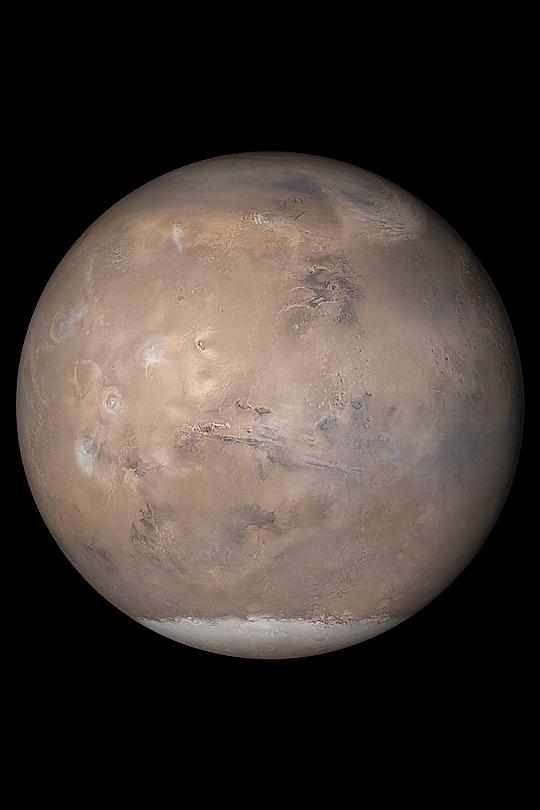
Pluto
Did You Know?
Pluto was reclassified as a dwarf planet in 2006!
The Dwarf Planet
Pluto is a dwarf planet in the Kuiper Belt, discovered in 1930 by Clyde Tombaugh. It was considered the ninth planet until 2006 when the International Astronomical Union redefined what constitutes a planet. Pluto is smaller than Earth's Moon and has a highly elliptical orbit that sometimes brings it closer to the Sun than Neptune. Despite its small size, Pluto has a complex geology with mountains, glaciers, and possibly an underground ocean.
New Horizons Mission
In 2015, NASA's New Horizons spacecraft made the first close-up observations of Pluto, revealing a surprisingly complex world. The mission discovered mountains of water ice, nitrogen glaciers, and a thin atmosphere. The most striking feature is a heart-shaped region called Tombaugh Regio, a large glacier of nitrogen and methane ice. New Horizons continues to explore the Kuiper Belt.
Moons of Pluto
Pluto has five known moons. The largest, Charon, is so large relative to Pluto that they orbit around a point between them, making them a binary system. The other moons are Nix, Hydra, Kerberos, and Styx. Charon's surface is covered with water ice and shows evidence of geological activity, including canyons and smooth plains.
Amazing Facts
Pluto takes 248 Earth years to orbit the Sun
This fact reveals the incredible scale and wonder of our universe.
Click to flip back
Pluto's surface temperature is -229°C
This fact reveals the incredible scale and wonder of our universe.
Click to flip back
Pluto has a thin nitrogen atmosphere
This fact reveals the incredible scale and wonder of our universe.
Click to flip back
New Horizons took 9.5 years to reach Pluto
This fact reveals the incredible scale and wonder of our universe.
Click to flip back
Your Next Jump
Continue your journey through the cosmos